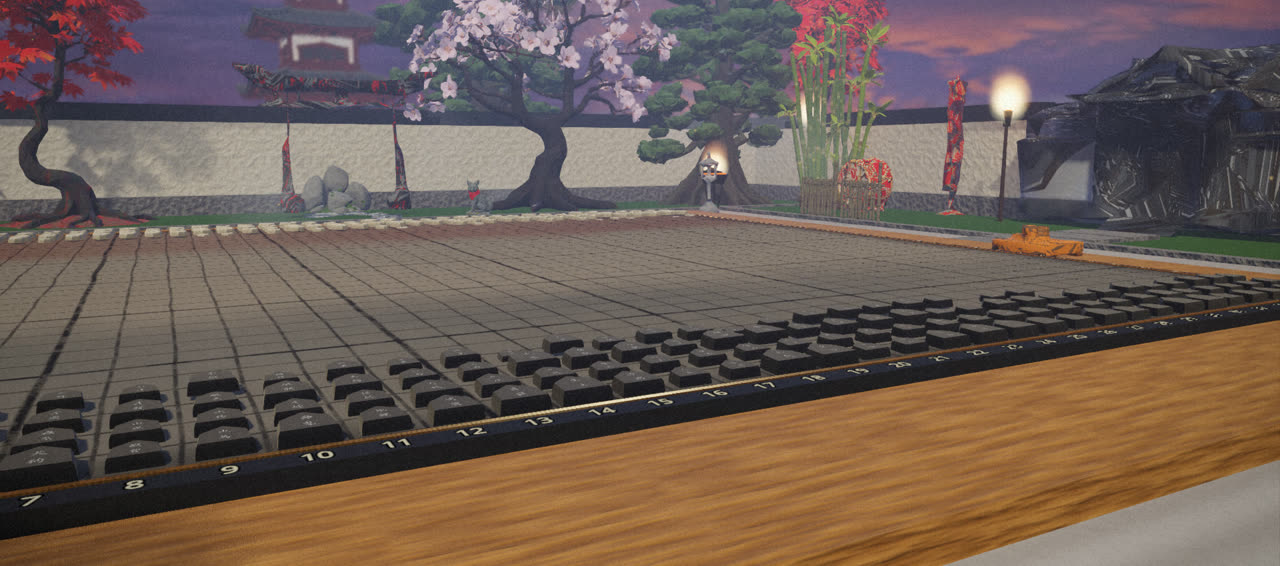
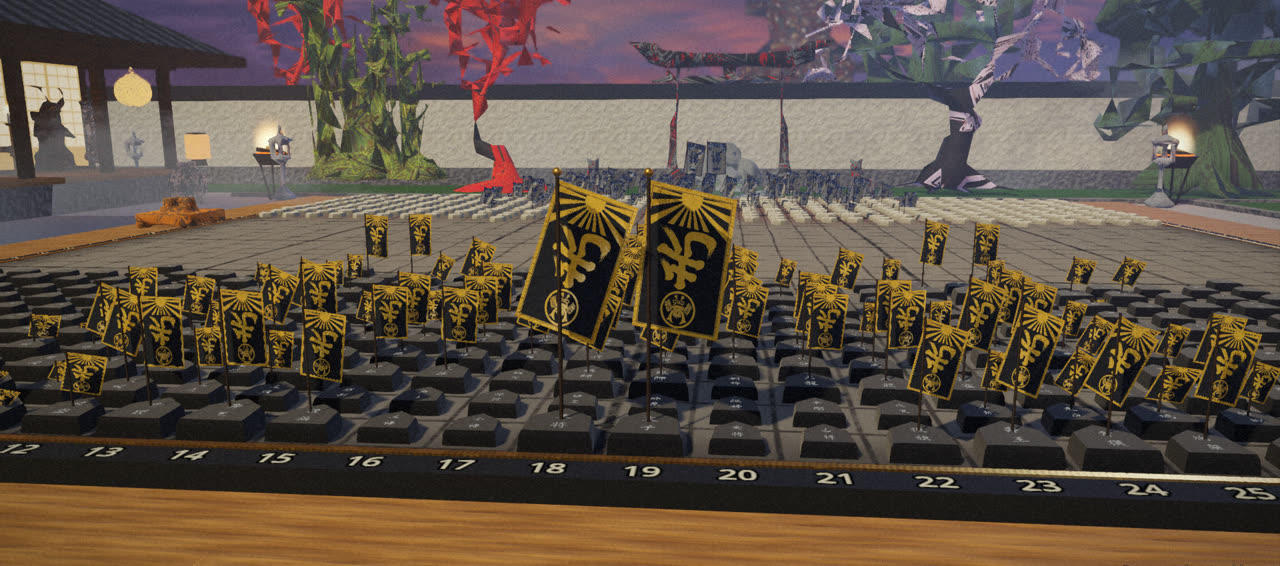
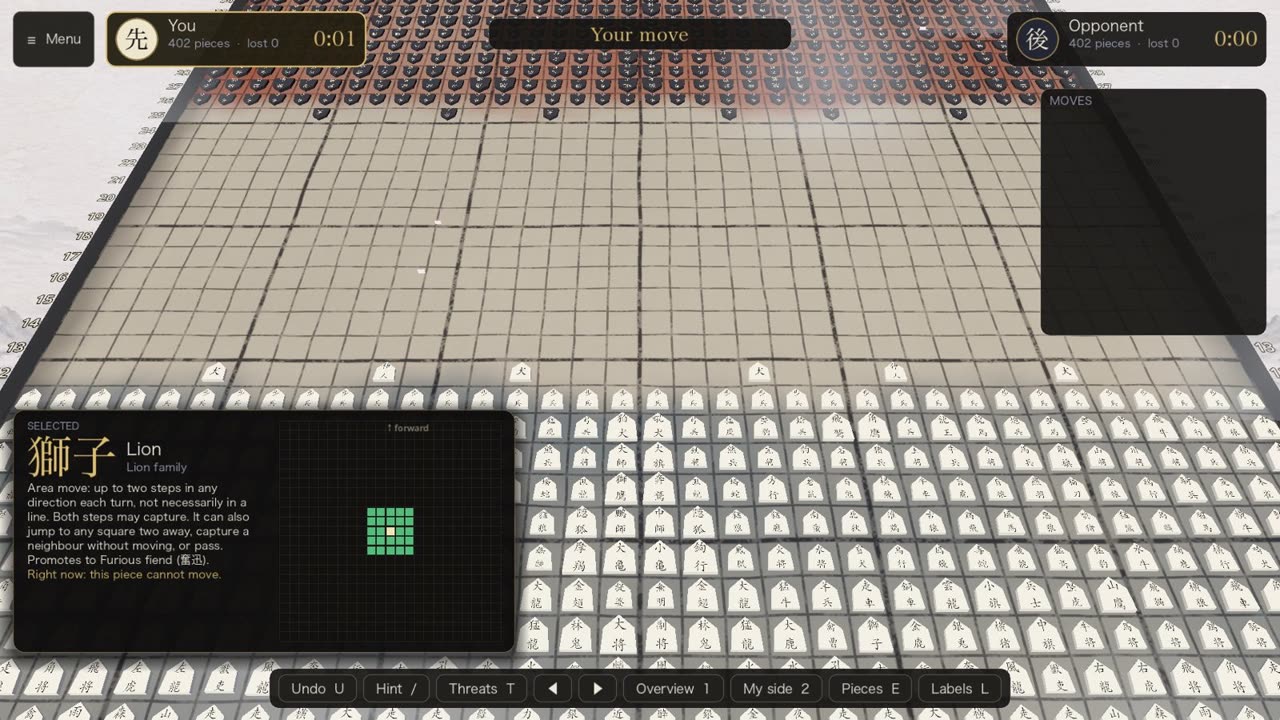
402 pieces a side on 36 by 36
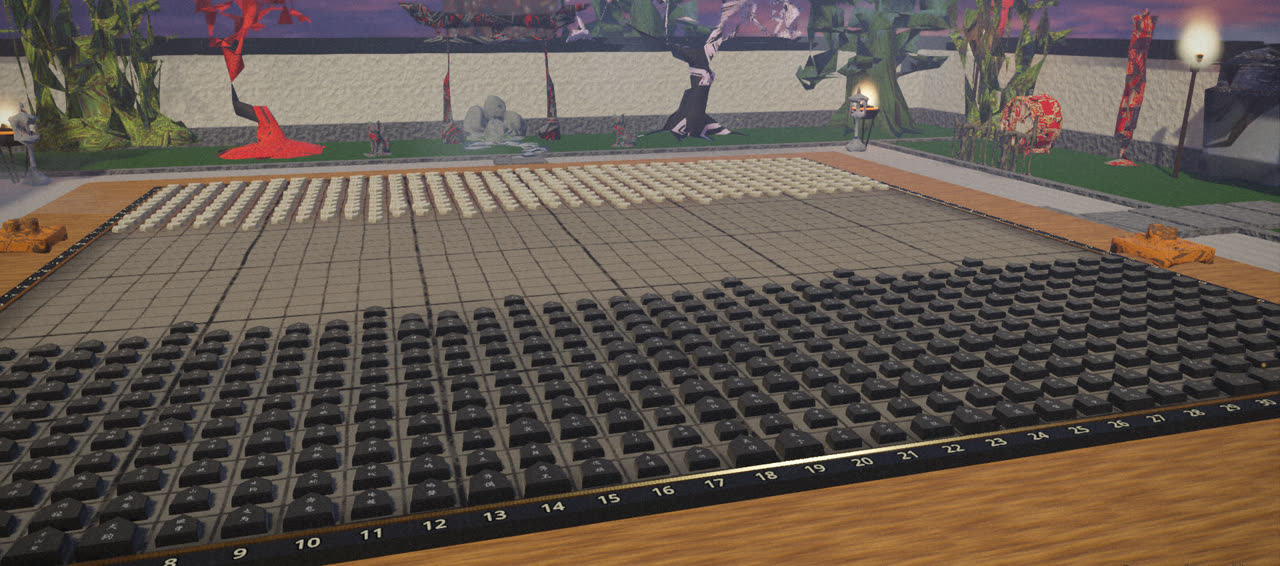
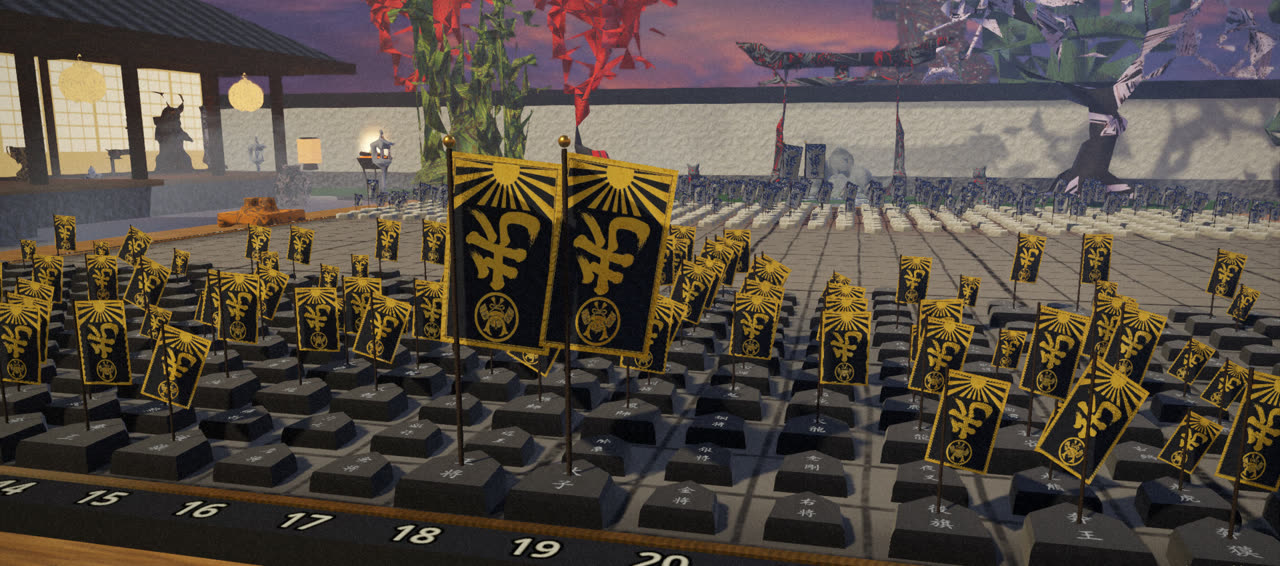
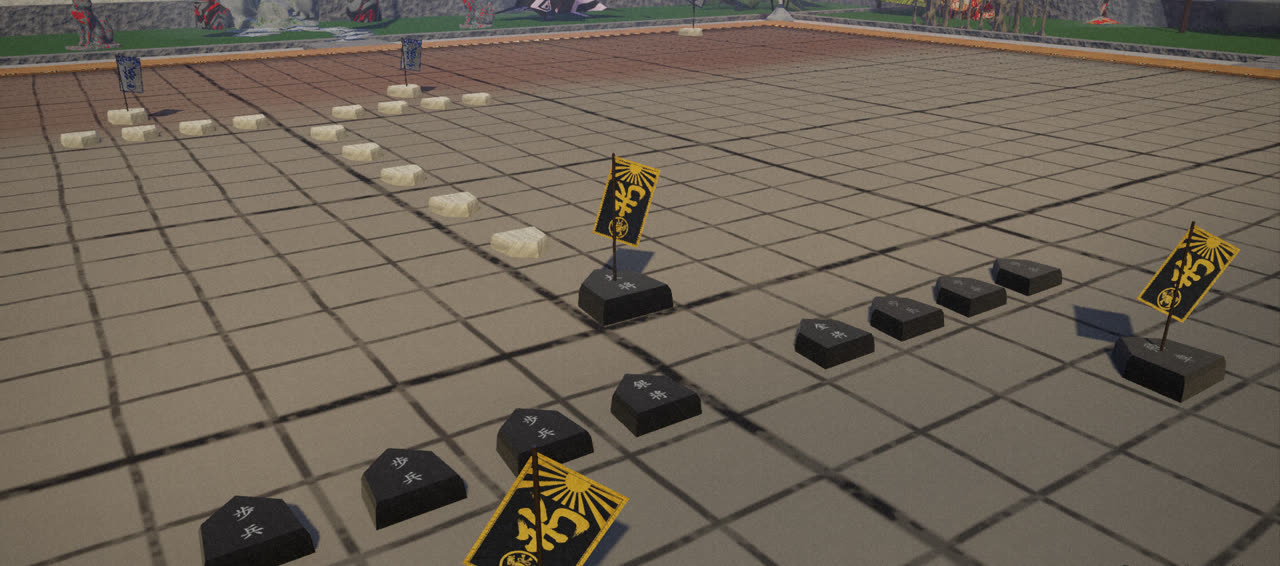
1,296 squares and 804 wedge-shaped pieces in the opening position. The largest shogi ever devised, rebuilt in 3D and played in a painted courtyard at dusk.
The largest shogi ever made. 36 by 36 squares, 402 pieces a side. Play the free demo in your browser.
Get the gameThe Player's Guide
Coming from chess? Same aim: capture the enemy king and crown prince. There is no check, so watch your own king. Captured pieces leave the board for good.
Out now on iPhone, iPad, Mac and Windows

A free 170-page PDF: the history, the rules, every way to play, how scoring works, strategy, every setting, and a page for each of the 301 pieces.
Get the free guide ›1,296 squares and 804 wedge-shaped pieces in the opening position. The largest shogi ever devised, rebuilt in 3D and played in a painted courtyard at dusk.

Lions strike twice in one turn. Eagles fly over their own pawns. Some pieces sweep the whole board. Every kind moves its own way, and you can see its moves before you commit.

From Kenji, who is still learning, to Kage, whom no one has seen without a mask. Each has a handicap, a personality and a scene of their own.
A short trailer with the teacher's voice and captions, and a two-minute history of the game.
The gameplay trailer · 0:55 · with the teacher's voice
Two players, one very large board, called by a host and a co-host.
Nothing is sent to YouTube until you press the button. Between streams the player can say the video is unavailable; Twitch and the Live page always show the current schedule.
Say TIE-kyoh-koo SHOH-ghee. “Tai” rhymes with “tie”, “kyo” is “kyoh”, and the last “ku” is quick and soft, like “koo” said almost under your breath. In “shogi” the o is long and the g is hard, as in “get”.
Taikyoku means “ultimate”: the great, whole board. Shogi is Japanese chess, written with the characters for “general” and “board game”. Together, the ultimate shogi: a 36 by 36 board and 402 pieces a side.
Taikyoku shogi (“ultimate shogi”) is a centuries-old variant played on a board of 1,296 squares. Each side commands 402 wedge-shaped pieces. Almost every kind of piece moves in its own way. It was almost lost to history, and this is a playable version of it.
A guided first game of eight short lessons on the real board: your first move and capture, promotion, protecting your king, looking around, the lion, leaping and the whole army. Each waits until you are ready. A teacher’s voice (in the full game) and always-on captions guide you. More about the lessons ›
Climb from Kenji, who is still learning, past Hana, the grandmaster, to Kage, whom no one has seen without a mask. Each has a handicap, a personality and their own scene. Earn up to three stars on each.
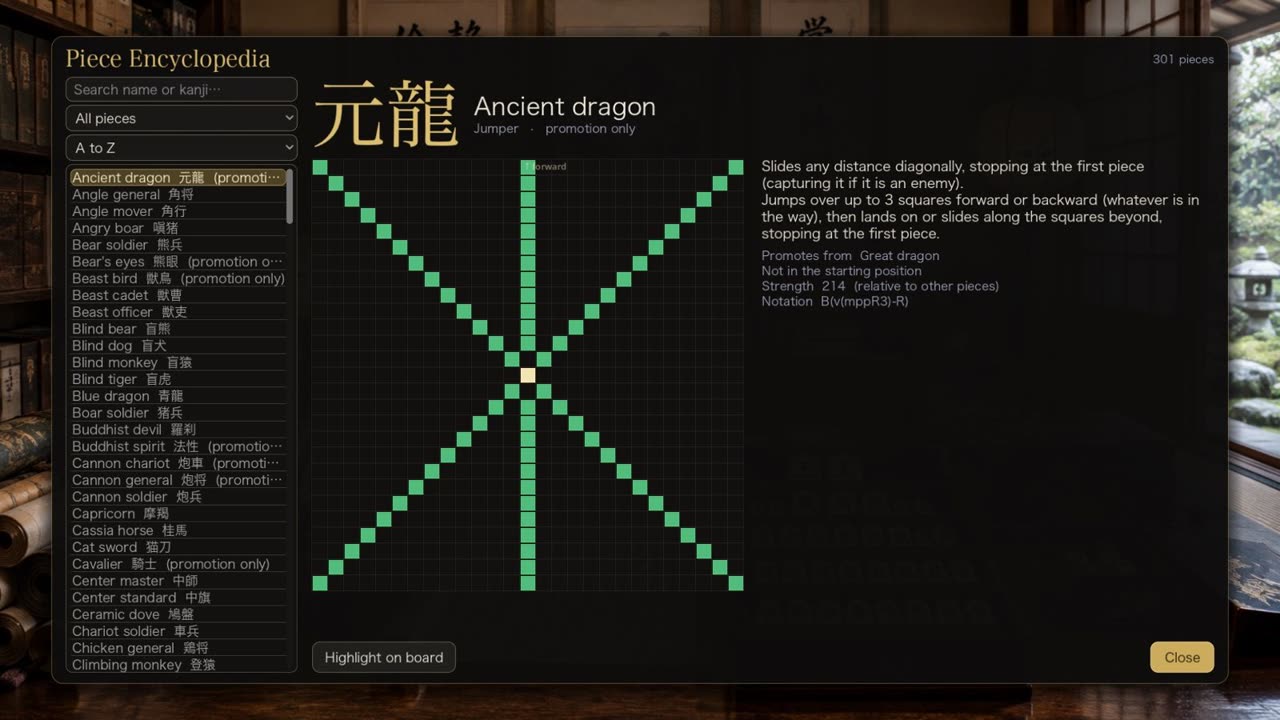
All 301 pieces with movement diagrams, plain-English descriptions and promotions. Hover any piece in play and its moves appear instantly.
Small positions with one winning idea. Find the move that wins, the lion capture that takes the most, or the forced win in two. Try today's puzzle here ›
Watch the AI play itself at up to eight times speed. Step through any game, jump to any move, and copy a whole game to the clipboard to share.
Play the computer at three strengths, a friend on the same computer, or another player online, live or over days (beta). The camera follows the move, with a calm cinematic mode.

Climb from the novice to the shadow. Press a portrait to meet them.









The ten opponents are fiction (lore), and their portraits are AI-generated paintings. The pictures and the voices are disclosed in full on the Live page, in the terms and in the game under Settings, Licenses and credits.
The Mac download is now signed and notarized by Apple, so it opens with a double-click and no warning.
The 3D piece pictures are back. In beta 89 the Piece Encyclopedia and the selected piece card showed an empty space where the piece should be.
Captions are now off by default on every platform. You can turn them on in Settings, under Captions.
Ranked games, slow games over days, and a ladder to climb. Online play is in beta, so expect rough edges and the odd server restart.
Beginner, Club, Expert and Master rooms pair you with players of a similar strength. Public games there are rated.
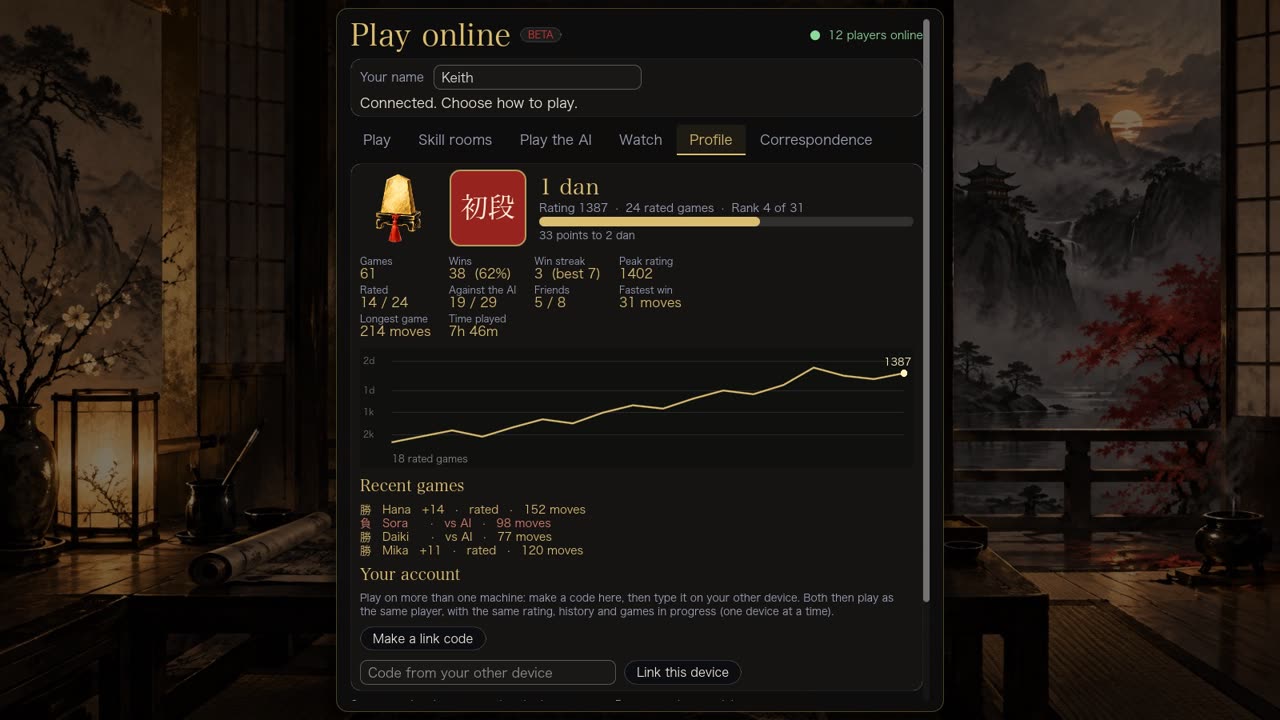
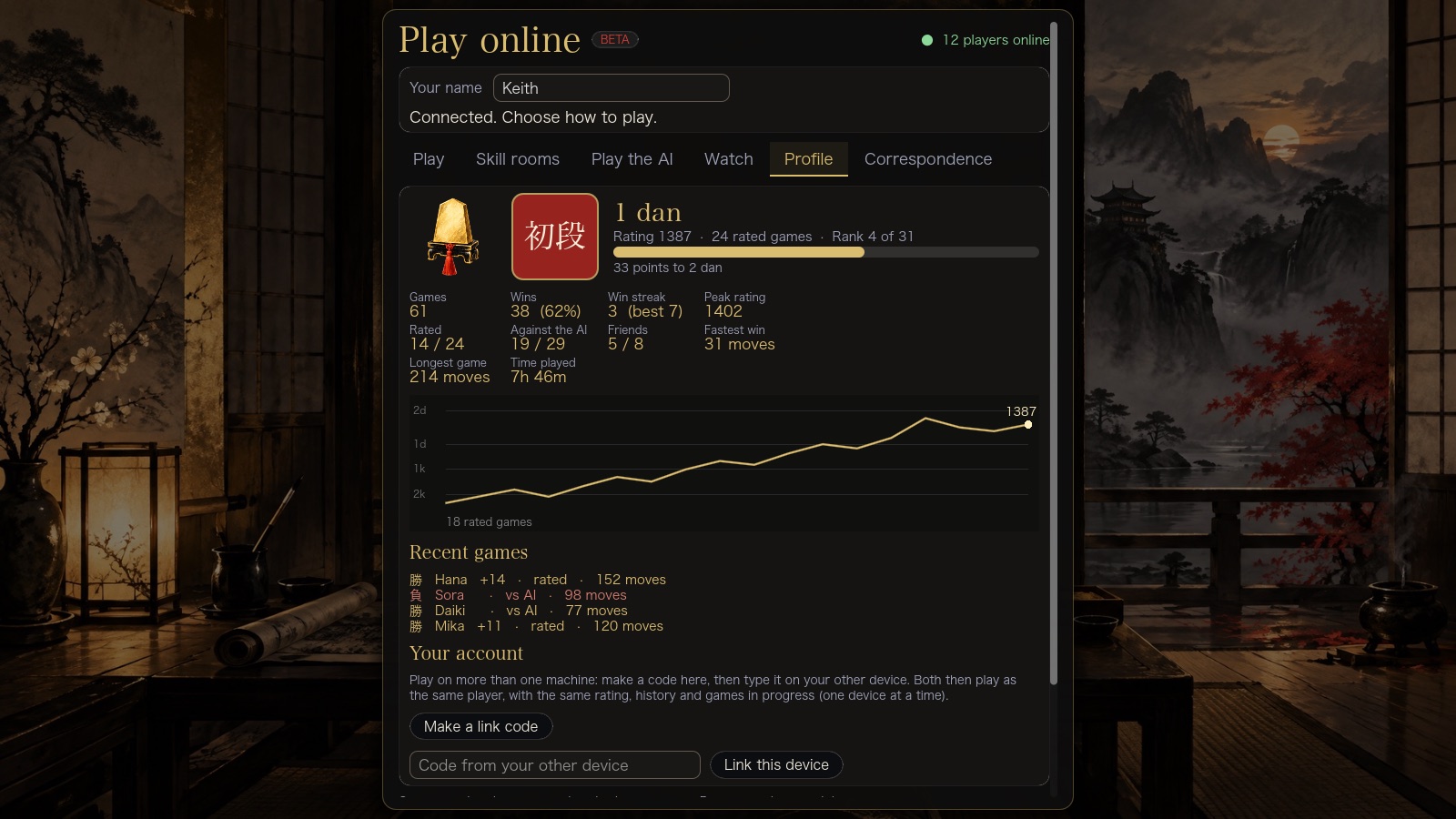
Your rating becomes a grade, from kyu up through dan. Your profile keeps your wins, streaks, rating curve and every recent game.
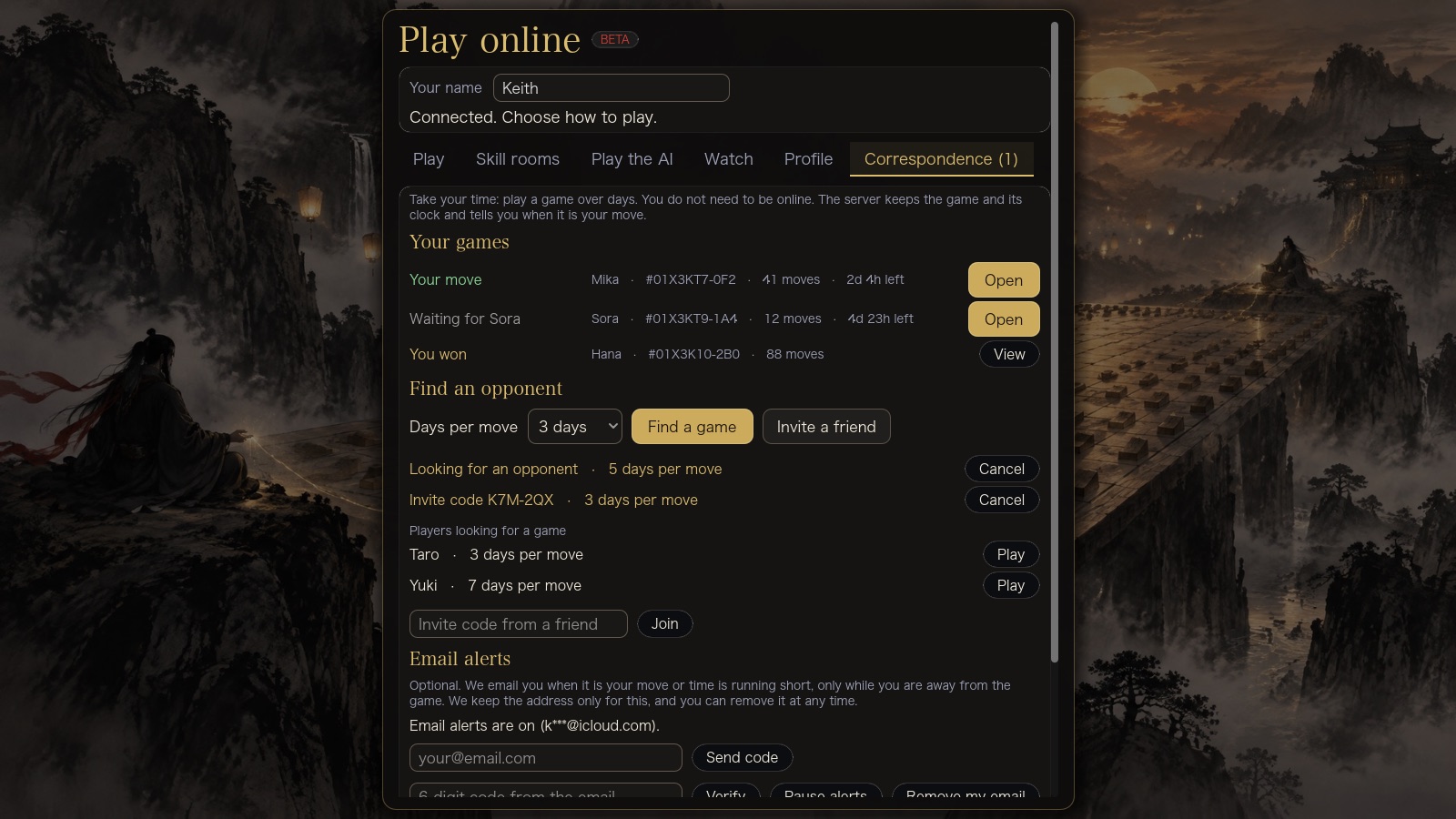
Take 1 to 14 days a move. Close the game and come back: the server keeps the board and the clock, and can email you when it is your move.
Make a private game and share a short code, or challenge a stronger player and take a fair handicap. Every move is checked by the server.
Watch public games as they happen and follow the leaderboard. The AI vs AI channel is on Twitch and YouTube.
No account to make. Every player gets a number, and a one-time link code moves your rating, history and games to another device.
Nobody knows who made the game. It is thought to come from the Edo period and is known from an old family document; some say priests, but there is no proof. It is not known to have been widely played, and it came back to light in 1997.
At least two sets of restored pieces exist. In 2004 a Japanese television show staged a real game: 3,805 moves over 32 hours and 41 minutes. The surviving record is short and scholars have to interpret the rules, so this version follows one careful reading and lets you change the promotion rule.
Sources: English Wikipedia, “Taikyoku shogi” (CC BY-SA 4.0), and Japanese Wikipedia, which follow Isao Umebayashi, Sekai no Shogi (1997), L. Lynn Smith’s English translation at The Chess Variant Pages, and George Hodges, Ten Shogi Variants (2002). Move notation: Ralph Betza’s funny notation. The game includes a narrated history.

Taikyoku shogi has 36×36 squares, 402 pieces a side and 301 kinds of piece. We are writing down its mathematics properly: a formal model, exact counts computed by the game's own engine, closed forms for how far a piece can move, the algebra of range capture, and open problems. The next step is to formalize it in Lean 4, so the claims become machine-checked theorems.
Taikyoku Shogi is out now on the App Store for iPhone, iPad and Mac, and on the Microsoft Store for Windows. Android is in closed testing and Steam is coming soon. Not sure yet? Play the free demo in your browser first. No account and no ads.
 iPhoneiOSGet it on the App Store
 iPadiPadOSGet it on the App Store
 MacmacOSGet it on the Mac App Store
 WindowsWindows 10 and 11Get it from Microsoft
 AndroidPhones and tabletsIn closed testing
 SteamWindows, macOS and LinuxComing soon
Computer players with their own names and faces play full 36×36 games, with a narrator. Pick a channel and follow along.
New builds, fixes and when online play opens up. No spam, and you can reply to any email to be removed.
No. Taikyoku Shogi is a paid game: one purchase, everything included, with no ads and no account. The free browser demo lets you try it first.
No. The game is in English and Japanese. A first game of eight short lessons teaches the basics, and you can switch the piece labels from kanji to English names at any time (press L, or use Settings). Hover over or tap any piece to see how it moves.
The one real recorded game took 32 hours. Yours will be shorter: the ladder opponents give you handicaps, and the AI plays quickly. You can pause and resume at any time, and the game autosaves.
They follow the surviving descriptions as compiled on Wikipedia, which disagree in places. Promotion in particular is uncertain, so you can choose among three rules. See the History chapter “Rules we are unsure of”.
iPhone and iPad, and Mac, from the App Store; Windows 10 and 11 (64-bit) from the Microsoft Store; and the free browser demo in any recent browser. The Android version is in closed testing and a Steam version is in preparation. We will say so here and by email when each one is available.
Mostly, yes. Playing the computer, the eight-lesson tutorial, puzzles, replays and the Study area need no connection. Online play, the live Watch page and the update check do.
Yes. Two people can share one computer, play online with a private invite code, or play a correspondence game over days. A stronger and a weaker player can use a handicap.
Yes. The AI vs AI channel is on Twitch and YouTube: computer players play full games with a narrator whenever the channel is on air (the Live page has the links). Public online games between players can also be shown there and kept as replays and highlights. Before you can use “Find a game”, the game asks you to accept that public games can be watched and broadcast with your display name and moves. Private invite games are never broadcast, and playing the computer is never shown.
Yes. Ten AI opponents of different strengths are always online, from a gentle beginner to a hard opponent. The ratings and dan grades in the game are this game's own Elo scale, not Japanese amateur grades. Skill rooms match you with players of similar rating, and if nobody is found within 20 seconds the game can give you an AI of similar strength. You can also challenge stronger opponents with a handicap: the stronger side starts without some of its best pieces, based on the rating difference. AI games are practice games: not rated and never broadcast.
Yes. Choose Play online in the game to be matched with another player, or make a private game and share the code with a friend. Every move is checked by a server, and a game survives a dropped connection. Online play needs the latest version; older versions are asked to update.
The music (Suno), the teacher’s voice and sound effects (ElevenLabs), the paintings (OpenArt) and the 3D figurines and gear on the pieces (Meshy) were produced with AI tools. The game design and code are by the author. The Japanese translation and voice were machine-made and have not yet been reviewed by a native speaker; please tell us what to fix.
Very little. The game has no ads, no analytics and no sign-up. It goes online to check for updates when it starts (the direct download only; you can turn that off in Settings) and when you choose online play. For online play our server keeps a random anonymous ID, the display name you choose, your moves and your rating; public games can be watched and may be shown on streams, and private invite games never are. Your saved games, settings and statistics stay on your computer. If you use the feedback form in the desktop download, it sends the message you write. On this website, Google Analytics runs only if you agree in the cookie banner. See the Privacy Policy.
Write to hello@taikyokushogi.com. To see, correct or delete the data we hold about you, use the Privacy requests page. We answer within 45 days, usually much sooner.
 TwitchWatch AI games live on TwitchOpen Twitch
 YouTubeLive games on YouTubeOpen YouTube